Through this swim around the Isle of Arran, I’m raising funds for the vital marine conservation work of Community of Arran Seabed Trust (COAST). You can donate via this JustGiving page here.
For my other daily blog posts, please click here.
This was always going to be a long day and it didn’t disappoint. I was expecting a slightly adverse tidal flow in the first couple of hours and then better conditions after low water. The reality was almost the opposite.
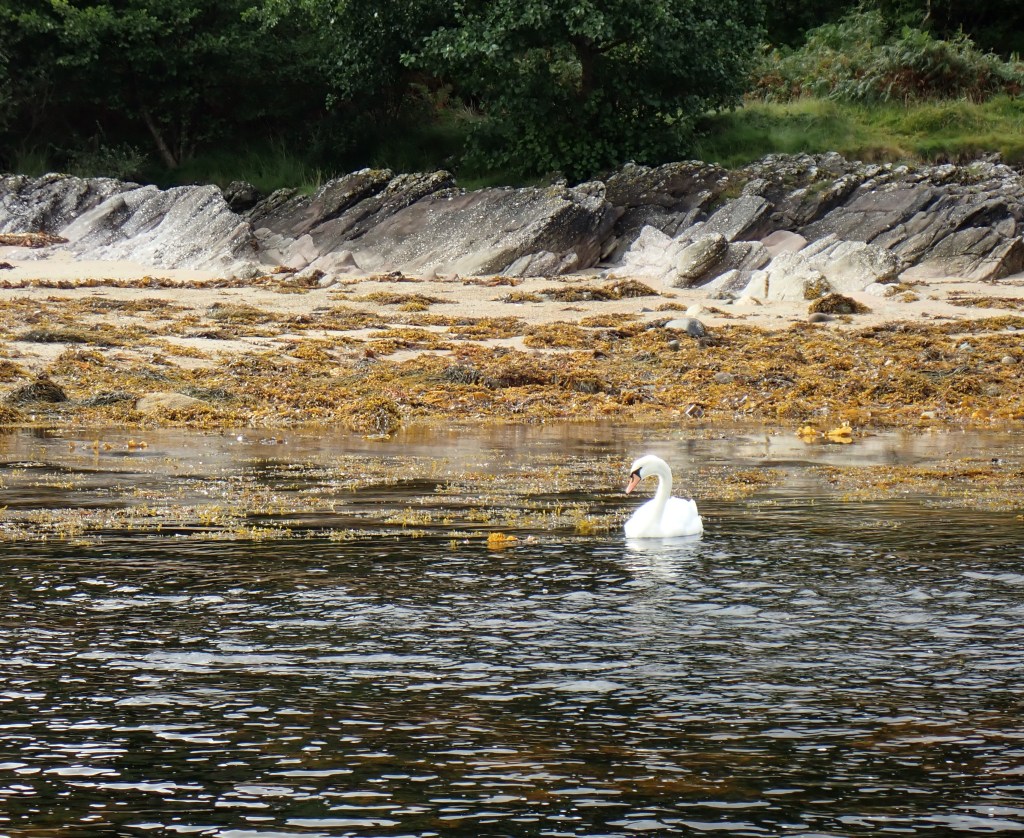
Steve and I arrived back at the beautifully mown picnic spot at North Sannox. A robin sang, a mute swan (perhaps the same one as yesterday) fed peacefully in the burn and we each immediately acquired a halo of midges.
I got in at the mouth of the burn, where the water was sweet and salt, and turned northwards. I floated over a mosaic of chocolate kelp and caramel wrack, with the occasional dash of sea lettuce and a tomato-coloured weed I think might be red rag.
Patches of white blonde sand appeared to have become graveyards for hundreds of razor shells, lying alongside a scattering of cuttlefish bones.
The tide was still pulling southwards down the Clyde estuary. So, to try and stay out of the way of any tidal flow running south, I tucked in close to the rocks, where the water was only a metre or two deep. My finger tips periodically combed the thong weed and grazed the stout grey stones blistered with barnacles.
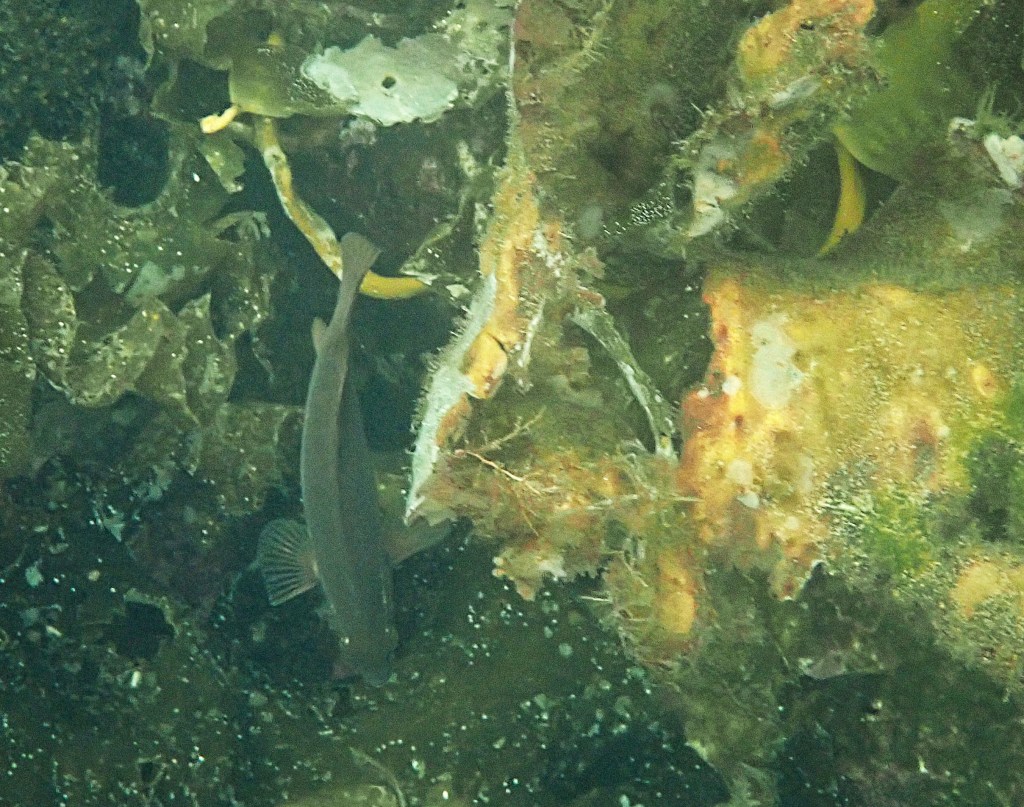
I love this sort of swimming. There’s the comfort of being close to the shore for a start. But there’s also a reignition of senses that start to shut off when staring into the vault of very deep water. Here I was gliding over boulder fields and variegated thickets of kelp grazed by bleached pink sea urchins. Shoals of sand eels shimmered, ballan wrasse loitered and baby pollock dawdled and darted over the sand clearings.
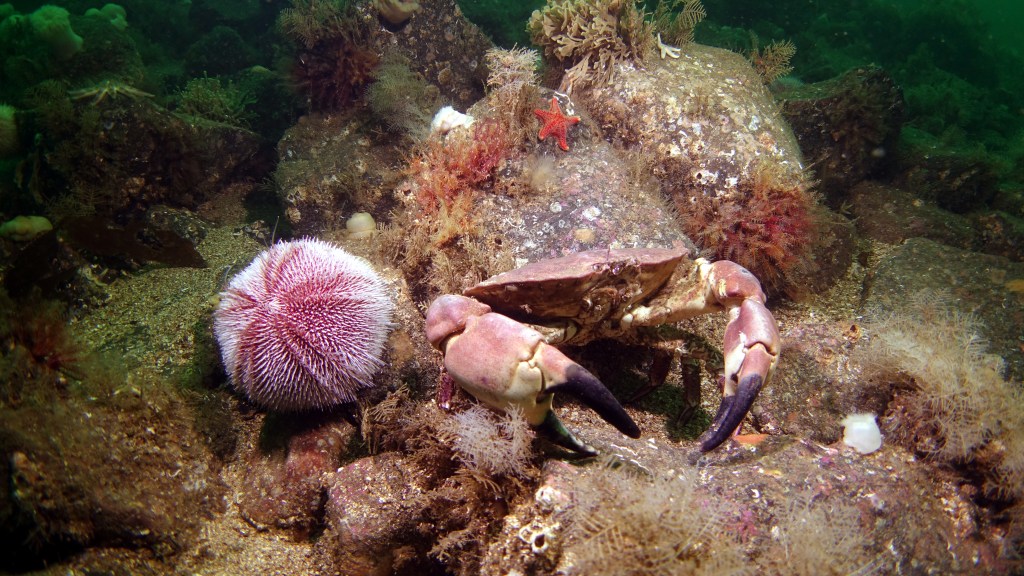
I saw – for the first time away from the fishmonger’s ice tray – an edible crab edging its way between the sprays of weed. It displayed a turn of speed as I dived down for a closer look and deftly wedged itself against a small shelf of rock.
COAST as catalyst
Compared to the previous day – when I was mostly some way offshore and the sea was churned – this felt like more of a window on the underwater worlds that Community of Arran Seabed Trust (COAST) is working to protect.
In my blog on my first swim out of Lamlash Bay, I pulled from COAST’s excellent website to describe a little of the organisation’s origins, how they succeeded in establishing a historic No Catch Zone and the impact this has had around and beyond Arran.
COAST’s catalytic role also shows up in last year’s celebrated film, Ocean with David Attenborough. A feature length natural history documentary with a cinematic release, the film stirred a vigorous debate within the UK and beyond about the impacts of destructive fishing practices, notably bottom trawling. These are revealed in devastating fashion in the film, through cameras attached to fishing gear as it eviscerates the ocean floor.
Arran features in the film, as a powerful illustrative case study of the obliteration caused by scallop dredging. What’s less apparent, though, is the role COAST played in making the film happen in the first place. As described on COAST’s website, COAST founder Don McNeish and his film-making nephew Doug Anderson first began discussing the idea of a film two decades ago.
During the Covid pandemic Doug Anderson and former COAST trustee, Tom Appleby, worked to develop the concept. In 2022 film crews began gathering footage in locations around the world, including Arran.
The film that emerged in 2025 “weaves together breath-taking marine imagery with uncompromising truths about ecological damage, political inertia, and, most importantly, the transformative power of community-led action. This is not just a documentary about what’s at stake; it’s a testament to what becomes possible when local people lead the charge for change.”
I was fortunate enough to watch the film at its premiere last year and was deeply moved and inspired by it. I was also extremely impressed by the care and skill that went into crafting a message that blended urgency and optimism. I came out wanting to watch it again, this time with my family.
After my weak attempt to sell the film as an extension to the Ocean’s 11 franchise foundered, my teenage kids reluctantly signed up. The deal with my daughter was that she could tell me afterwards that it was every bit as boring as she had predicted.
Coldplay’s song over the credits got a firm thumbs down. But I took as a win the succinct verdict on the film itself: “Dad, that was actually quite good.”
A gruelling second half
The first half of the swim proved to be a honeymoon. The tidal flow was not against me as I expected. I may, in fact, have been getting a slight push, perhaps due to an eddy close to the rocks. This, or maybe the fix of nature-gazing, helped me cover over 6.5 kilometres by the time I had my two hour food and water break.
By this point, the tide had definitely turned. I thought that, as it began to rise and build momentum, I would get a helpful shove northwards. Soon after though, it – or some localised current – began pushing me back slightly. Perhaps the wind was more of a factor, as it pivoted from more or less southerly to something closer to northerly. The waves were small but, each time they smacked into my head and shoulders, a little more momentum and energy ebbed out of me.
I did get a helping hand (or flipper), from a sociable seal that tailed me through a good part of my third hour. Like the one I met near Brodick, it kept a respectful distance and having it with me was a cheering distraction from the elements.
As I passed the Cock of Arran, close to the northernmost point of the island, there was no doubt about what was going on with the tidal flow. Beneath me the current beat the long frizzy sprays of copper-coloured wireweed and trails of thong weed down to a 45 degree angle and pointed them straight at me. I was cold and knew I was struggling. I knew, too, that if I stopped here, Steve and I would have a horrendous trek with the kayak round to Lochranza. That seemed a lot worse than plodding on, one stroke at a time, and trusting that I was still moving in the right direction.
Sighting Lochranza, which nestles beside the sea loch of the same name, restored things, mentally and physically. The last half hour past Newton Point and across the channel was a delight.
The swim took five hours. Around 45 minutes before I finished, my watch said we were at 11.4km. Shortly after that it buzzed, died and (as I later discovered) seemingly erased all records of the swim. But an analogue estimate, based on the archaic art of placing a piece of string on a map, suggests that the distance was close to 13km. I think that makes it my second longest-ever swim.
Today (Tuesday) the westerly winds hitting Lochranza and the coast to the south west are forecast for force 6-8 and, for me at least, that’s too much for a swim. All being well, I’ll be back in the sea tomorrow and heading down towards Pirnmill.


Leave a Reply