Through this swim around the Isle of Arran, I’m raising funds for the vital marine conservation work of Community of Arran Seabed Trust (COAST). You can donate via this JustGiving page here.
For my other daily blog posts, please click here.
“I don’t know whether a weather front strengthens or weakens just before it passes overhead,” said Steve. “We’re about to find out.”
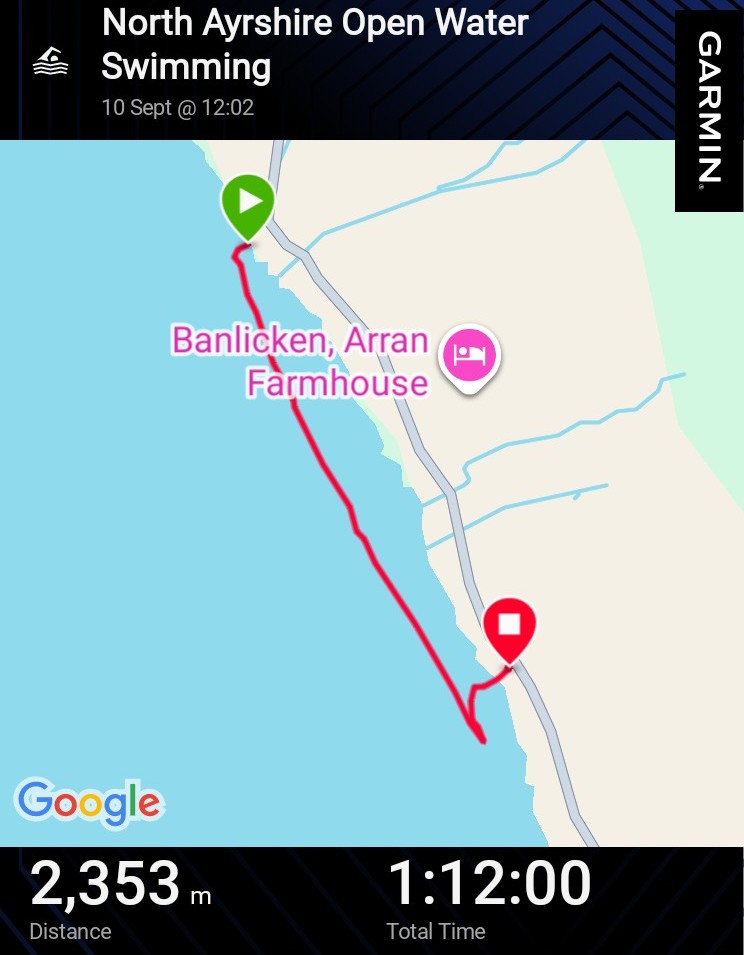
On Thursday, we were back near Imachar Point. When we finished here, on Wednesday, the sky was clear but for thin sheets of high cloud absorbing the last of the dipping sun. Now the waves massed on a stone grey sea that blurred into the sullen sky. The wind was force 5 and driving up the coast from the direction we wanted to go.
Once in the water, I focused on getting my shoulders clear of the water, adapting my movement as best I could to the shifting rhythm of the sea. Arms had to turn slowly to allow waves to pass over my head, then speed up to grab the gaps between them. Sometimes I had to leave a stroke unfinished, as the sea seized my wrist.
My head and chest bobbed and crashed like the hull of a small boat. I could feel a slight reverberation throughout my body each time I thudded into a trough.
We were sighting on a slight promontory to the south. The waves threw up wall after wall and I had difficulty holding a straight line. The wind picked up, gusting to force 8.
I wanted to take control of the situation and try and muscle my way through it. Looking back, my main achievement of the day was resisting that impulse. In a fight with the sea, there is only one winner.
I tried to relax and focus on breathing out to breathe fully in. I had some success amidst many snatched gulps of air. But I was swallowing far more sea water than usual. I wondered if topping it up with an energy gel at the first hourly feed break would make me vomit.
When an hour was up, Steve somehow held his pitching kayak straight into the wind while unwrapping and passing me a cereal bar. Treading water, spitting out water and trying to force down the food, two things quickly became apparent. One was that, in an hour, I had covered less than two kilometres. The other was that, when not swimming or paddling slowly forwards, we were going backwards.
Pressing on seemed possible. The weather front was due to subside in an hour and the tide was swinging in our favour. We concluded it wasn’t worth it. I would use up a huge amount of energy to cover a fraction of the distance that good conditions might permit. And that raised a safety issue – being drained and wrung out in such a sea would limit the scope for handling any sort of problem or maybe even just thinking straight in the moment.
We headed for the beach. It wasn’t a beach. It was a steep pebble bank enclosed by a screen of large boulders. Steve called for me to go first so that I could receive his kayak when the sea hurled it onto the shore. But I was stuck on a big rock and no help at all. Steve was able to use his surf kayaking skills to ride the wave and deftly skirt the rocks before leaping out and hauling up the bank.
Calling Waves
Is it possible to enjoy swimming in such a turbulent sea? My swimming hero Mercedes Gleitze – an iconic swimmer of the 1920s and 1930s – seemed to think so.
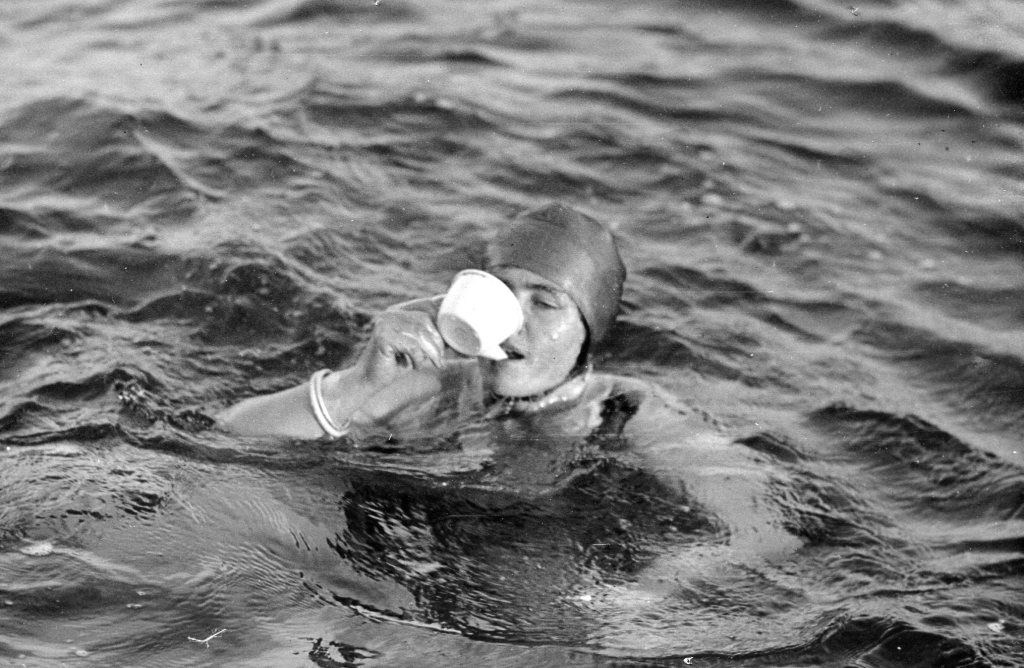
Credit: The Northern Whig & Belfast Post (British Newspaper Library/Gleitze Archives), courtesy of Mercedes’s daughter Doloranda Pember
Mercedes was the first British woman to swim the English Channel, the first person to swim the Strait of Gibraltar and the first person to swim round the Isle of Man. She broke not only physical barriers but social ones too – conquering a long list of previously un-swum channels, lakes and islands at a time when the concept of a woman pushing the boundaries of human endurance, and doing so on a professional basis, was neither established nor accepted.
Mercedes had a deep appreciation of the sea that I find extremely appealing. In a press interview in 1929 she told the reporter:
“I passionately love the sea; nothing else moves me as it does. I love and understand its every mood; and I sometimes fancy that the sea knows and understand me too.”
She also said that:
“I know no sensation but that of calm pleasure at the prospect of another tussle with those “calling” waves. When one loves, one is not afraid.”
I sometimes catch glimpses of what Mercedes describes. On days when I trust my energy levels, my stroke and my ability to stay warm and to keep breathing, the buffeting of the waves feels more pillow fight than brawl. I know that I will immediately be lifted up after being thrown down. The absolute immersion can feel soothing.
Thursday, though, was not one of those days.


Leave a Reply