Through this swim around the Isle of Arran, I’m raising funds for the vital marine conservation work of Community of Arran Seabed Trust (COAST). You can donate via this JustGiving page here.
For my other daily blog posts, please click here.
Yesterday, the eighth leg of the swim began at the Sliddery seaweed carpet we landed on the previous day. I’m afraid I passed on the opportunity to forage for some ingredients for the evening meal. I was keen to get started and spent the first half hour in the company of a family of swans who formed a graceful flotilla just inshore from me.
I was a little anxious about this swim and also aware of how irrational this was. The sea was the calmest it had been since I started, the coastline ahead was stunning and the sun was out. My slight doubt was not knowing what the tides might do.
Going north up the east coast of Arran and south down the west, assessing which way the tidal flow might move was relatively straightforward. Now we were heading west to east along Arran’s south coast. Would a falling tide curve round Arran’s southwest coast and give me a friendly shove. Or might it veer round from the southeast and hold me back?
The answer was neither. Starting just before 1pm, the tide was still rising (albeit weakly) for a couple of hours and I could feel a slight push against me. But that was offset by the advantage of swimming across a flat surface and, more importantly, the invigorating effect of drinking in a lovely coastal landscape both above and beneath the surface.
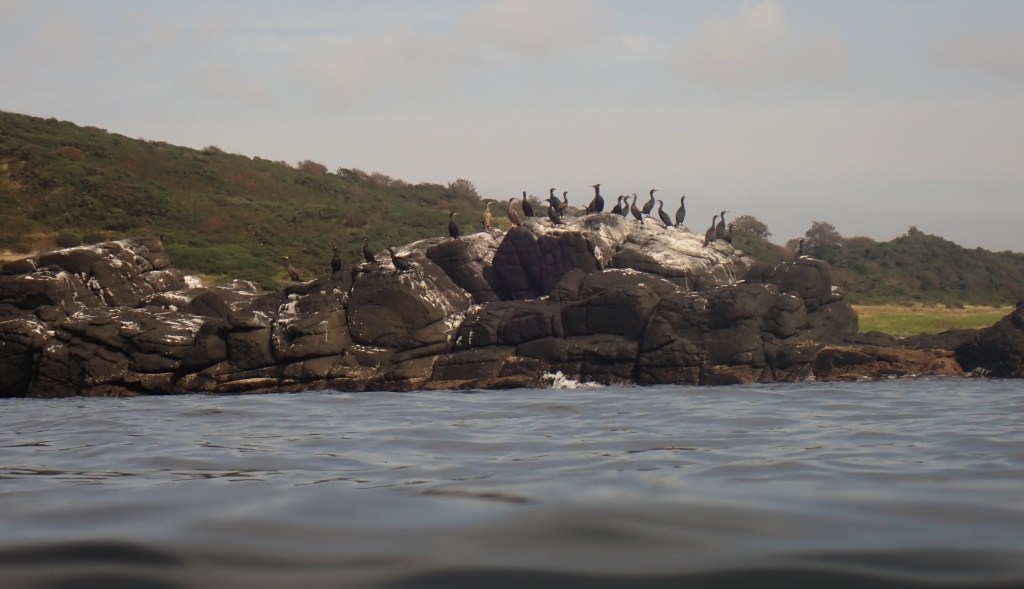
This stretch of coast is divided into plots by what geologists term a “dyke swarm” – reefs of basalt or dolerite that jut half a kilometre into the sea. With the tide not yet at its peak, I had trouble clearing several of these. It felt like the aquatic version of vaulting a series of dry stone walls.
Sea grass and cyanea
After five kilometres, below the hamlet of Shannochie, I found a seagrass meadow. The sun was not fully out so I didn’t experience its full verdant splendour. But I still got a thrill diving down and swimming between the swaying green ribbons. Such was my excitement that I failed to notice a loitering lion’s mane jellyfish and swam straight into it. I was fortunate to escape with stings to the wrist and ankle.
The pain was a little more intense than being rubbed with stinging nettles, while falling short of a wasp or bee sting. Those tentacles have legs, though. Writing this many hours after the encounter, I can still feel a slight throbbing and will probably have to grope around for some paracetamol before going to bed.
To me, lion’s mane jellyfish have few redeeming qualities. Sir Arthur Conan Doyle, however, recognised the species’ dramatic potential and wrote a Sherlock Holmes detective story about it.
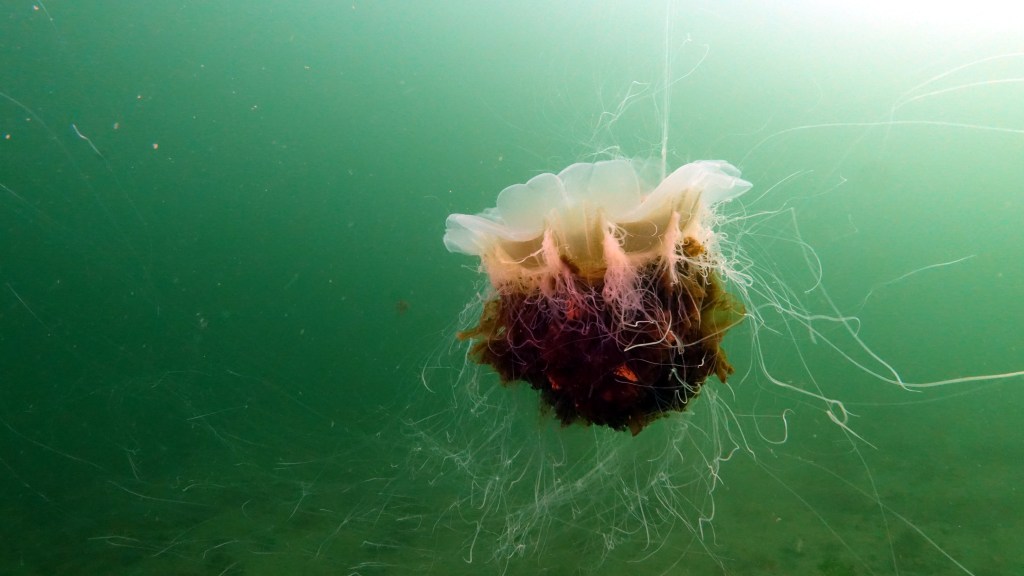
Many Sherlock Holmes stories provide the basis for TV and big screen adaptations but this is not one of them. The tale’s limitations start with the title – ‘The Adventure of the Lion’s Mane’ is a bit of a giveaway as to who the murderer might be. Perhaps film-makers have been also deterred by Conan Doyle’s questionable grasp of marine biology. In ‘The Adventure of the Lion’s Mane’, the eponymous villain hangs out in rock pools awaiting unsuspecting swimmers and delivers a salvo of stingers far more potent than the one that snagged me.
Still, it’s unlikely that many marine biologists can compete with Conan Doyle when it comes to a dramatic denouement to their investigations:
“I had reached the deepest and stillest pool when my eyes caught that for which they were searching, and I burst into a shout of triumph. “Cyanea!” I cried. “Cyanea! Behold the Lion’s Mane!”
The strange object I pointed did indeed look like a tangled mass torn from the mane of a lion. It lay upon a rocky shelf some three feet under the water, a curious waving, vibrating, hairy creature with streaks of silver among its yellow tresses. It pulsated with a slow, heavy dilation and contraction.
“It has done mischief enough. Its day is over!” I cried. “Help me, Stackhurst! Let us end the murderer forever.”
There was a big boulder just above the ledge, and we pushed it until it fell with a tremendous splash into the water. When the ripples had cleared we saw that it had settled upon the ledge below. One flapping edge of yellow membrane showed that our victim was beneath it.
A thick oily scum oozed out from below the stone and stained the water round, rising slowly to the surface.”
An escort up the Sound of Pladda
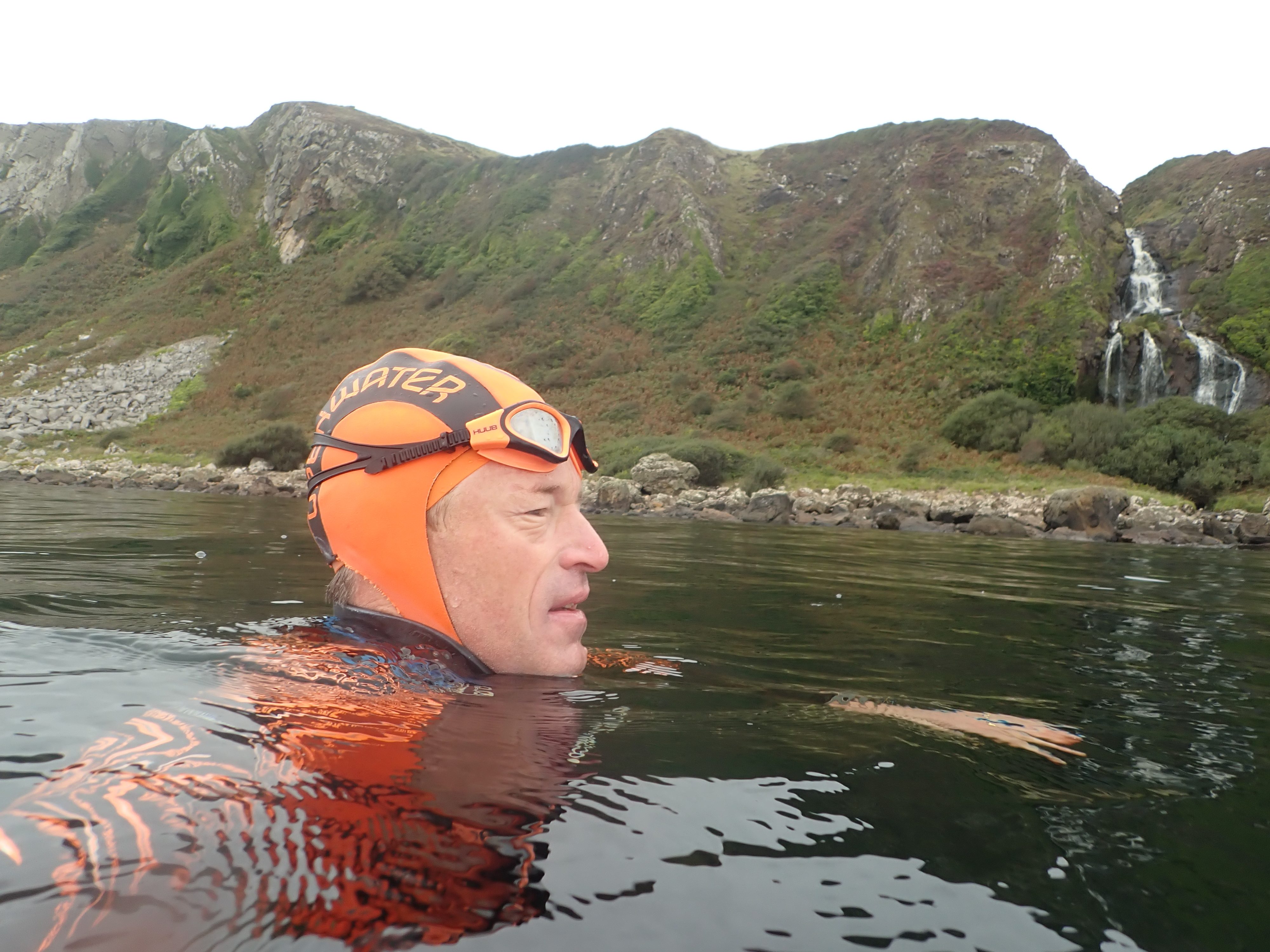
At the east end of Bennan Head, we drew level with a waterfall called the Falls of Struey. It spreads out across several small channels, like a liquid root system, as it cascades into the brine below. Immediately next to it is a hulking grey cliff punctured by the Black Cave, which author Geoff Holder describes as being the largest sea-worn cave on Arran. Evidence of human settlement of the cave include prehistoric arrow heads and flint flakes.
Beyond Bennan Head, I got a clear view of Pladda Island to my right and buildings at Kildonan – my finish point – three to four kilometres ahead. By this stage I had settled into the swimming equivalent of a trudge. But that was still enough to entertain a group of up to seven seals that tailed me for over an hour. In common with other seals I’ve met around Arran, this group displayed a blend of friendly curiosity and reticence; never coming closer than about four metres. Most of the time I couldn’t see them sneaking up on me. But, from time to time, as I breathed to my right, I’d see eyes and nostrils appear, followed by a snort and a splash.
As far as I can tell, seals around Arran have never been hunted as food. This contrasts with islands further north, where the consumption of seal meat was widespread in centuries gone by. Scottish writer Martin Martin, who visited Arran around 1695, also travelled to the Isle of Harris and details the hunting and consumption of seals there.
He also describes theological debate between a Catholic, who believed it permissible to eat seal meat during Lent, and a Protestant, who took a different view:
“[The Catholic said], ‘I have eat a sea-creature, which only lives and feeds upon fish.’
“The Protestant replied, that this creature is amphibious, lies, creeps, eats, sleeps and so spends much of its time on land, which no fish can do and live. It hath also another faculty that no fish has, that is, it breaks wind backward so loudly, that one may hear it at a great distance. But the Papist still maintained that he must believe it to be fish, till such time as the Pope and his priests decide the question.”
For the last hundred metres or so, as I approached Kildonan, the seals left me to my own devices. A wise choice, as I struggled to find enough water to float over the stones and belly flop onto the shore.
The swim took four hours 40 minutes and brought me 12 kilometres closer to my final destination – Lamlash – which I’ll try to reach today.


Leave a Reply