Through this swim around the Isle of Arran, I’m raising funds for the vital marine conservation work of Community of Arran Seabed Trust (COAST). You can donate via this JustGiving page here.
For my other daily blog posts, please click here.
Steve and I planned shorter swims for yesterday (Sunday) and today (Monday). The idea was to get just north of Sannox ahead of a long swim on Tuesday around the northern tip of Arran, where there is no coast road and fewer places to get in and out of the sea.
But, as of yesterday morning, the weather forecast predicted a very strong wind from the west on Tuesday, which would make that swim round the top of the island to Lochranza very hard. So we decided to use the day to make up as much distance as possible and set up the Lochranza swim for Monday.
We started where we left off Saturday – a slipway in Brodick, which is Arran’s principal ferry port, and historically, its main administrative centre.
The Phoenix Castle
Over the centuries, authority figures on Arran have tended to base themselves in Brodick Castle on the north side of Brodick Bay. Those wanting to challenge them have frequently prioritised seizing the castle or destroying it altogether.
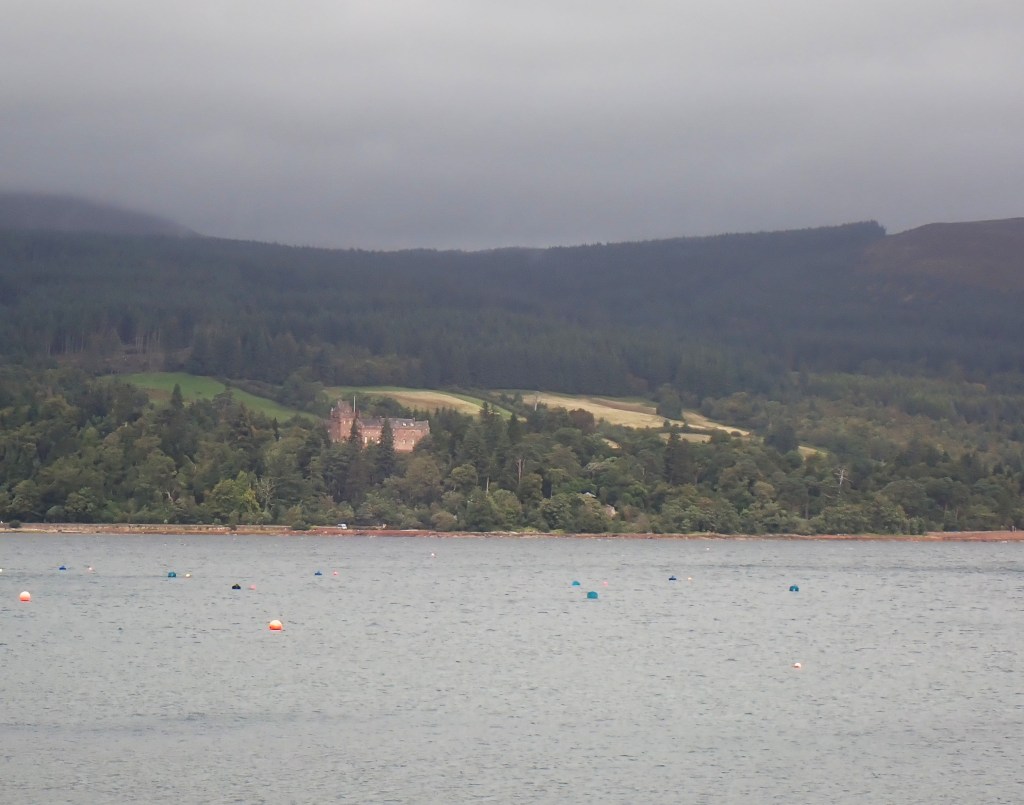
Thorbjorn Campbell, whose thoroughly researched book, Arran – A History, is a fantastic reference, says that the earliest known parts of the castle date from the end of the Thirteenth and start of the Fourteenth Centuries, during Scotland’s Wars of Independence.
Campbell describes the castle as “phoenix-like, rising from the ashes time and again.” Having read Arran – A History from end to end, I went back and tried to count the number of mentions of Brodick Castle being attacked, seized or burned down. I got as far as eleven. In a couple of cases the castle suffered two separate attacks in the space of a single page.
One of the earliest and most noteworthy assaults on the castle may have involved soldiers loyal to Robert the Bruce and taken place in 1307, at the start of Bruce’s seven year-long campaign to rid Scotland of English rule. There are some questions about the accuracy of this account.
It does sound more solid, though, than the tale of Robert the Bruce holing up in a cavern on the west coast of the Arran with the famous spider whose dogged efforts to spin a web taught him the virtues of perseverance. I’m hoping I’ll reach the King’s Cave, as it’s known, in the next few days.
The serial erasures and resurrections explain the castle’s distinct blend of architectural styles. Swimming out from Brodick, I got to glance at it each time I breathed to the left. It looks more stately home than fortress. Perhaps that’s down to the later additions, which date from the era of the big-spending eleventh Duke of Hamilton, Arran’s ruler during the mid-Nineteenth Century.
An informative blog by Sarah Beattie and published by the National Trust for Scotland, Brodick Castle’s current owners, describes Duke William’s death in Paris in 1863 at the age of 52:
“He had apparently been dining with [Duke William’s wife] Marie’s cousin Napoleon III, and unfounded rumours circulated that William had been injured during a drunken altercation between the two men.”
Thorbjorn Campbell offers a racier rendition of the same story. He includes a post-script, in which Duchess Marie reacts to news of her husband’s demise by assembling the contents of his Brodick Castle wine cellar on the shore here and smashing each bottle with a hammer or maybe a poker.
A swim of surfing and sliding
I didn’t realise how strong the wind was until I was out in the middle of Brodick Bay being swamped by waves rolling up from the south. Steve estimated it got up to force 6 gusting force 7.
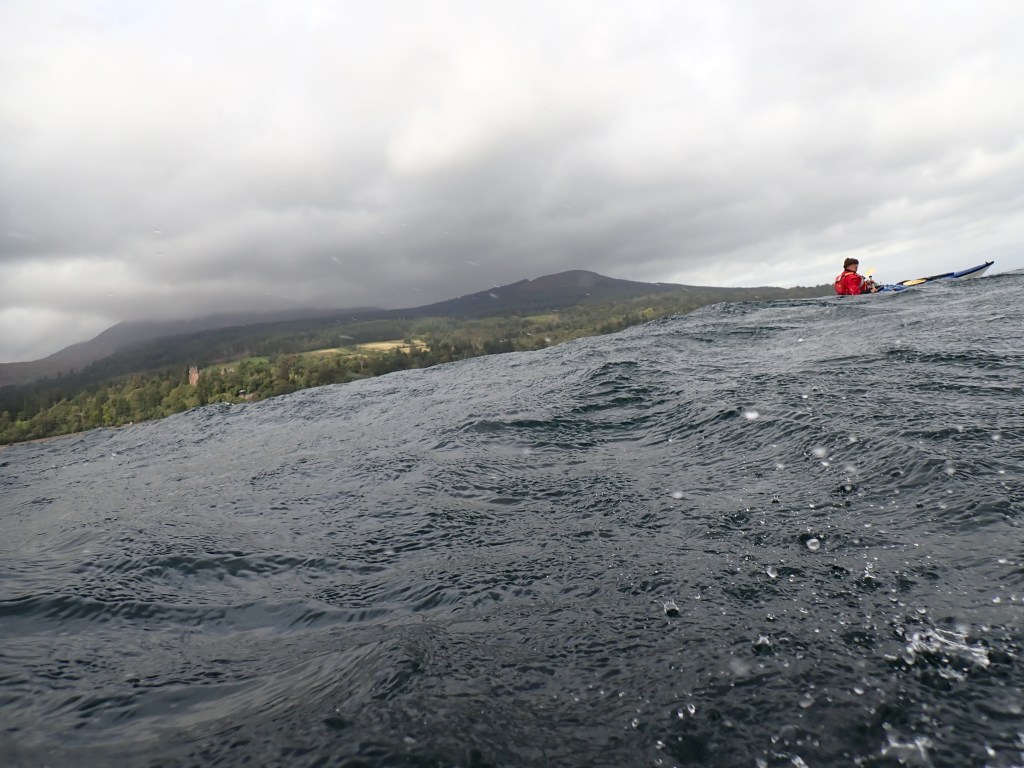
He told me afterwards he saw me unintentionally surfing down some of the waves and sliding down the back of others. I like to breathe every three strokes, so both left and right. By sticking to my routine, I let the sea fill my throat and I had to switch to every four, five or six strokes, doing my best to anticipate when the next bank of water was going to envelop my head.
Having a strong wind roll up the sea from behind you is vastly preferable to having it hit you in the face, which can make forward motion impossible. But it can be a hindrance too. There’s the inhaling of water rather than air and the sense of thrashing in treacle as your shoulders are submerged. I struggled on Saturday in Lamlash Bay with fairly small waves creeping up behind me. Today was different. These much larger waves seemed to push me along and I made much more rapid progress than the day before, even before the tide turned in my favour.
My hourly feeds were tricky though. The waves threatened to flip Steve’s kayak as he passed me my energy bars and gels and water.
Although less of a factor than the waves, I think I was swimming a little better this time. Steve gave me some great feedback during Saturday’s swim as he observed me repeatedly veering to the right as I yanked at the water. Today I tried to act on his advice, as well as concentrating on flow rather than power.
I’ve also been working recently on my breathing – pushing as much spent air as possible out of my lungs with each outbreath underwater. The idea is that this maximises space for the gulps of air you take as you turn your head to the side. I think it’s helping me.
The shore at Corrie – a wooden seal and buried boots
After about seven or eight kilometres, we drew level with the village of Corrie, which boasts a series of distinctive sculptures by local artist Marvin Elliott. These include an ingenious and very lifelike wooden seal basking on a huge boulder on the shore. I wanted to pose for a photo next to it but the pitching sea got in the way. You can see some great pictures of it in this BBC article, though.
Corrie sits below Arran’s highest mountain, Goatfell, a favourite of visiting mountaineers over the past two centuries. Thorbjorn Campbell writes that, during World War II, the peak provided a training ground for the 11 Commando force that unsuccessfully tried to kill or capture German General Erwin Rommel in North Africa in 1941.
In 1889 Goatfell was the scene of Arran’s most famous murder. Drawing from the Campbell book and The Guide to Mysterious Arran by Geoff Holder, the gist of the case is as follows. A visiting Londoner called Edwin Robert Rose and a Glaswegian called John Watson Laurie, who had only just met, made an impromptu decision to climb Goatfell. Subsequently both disappeared.
Over three weeks later, after an extensive search, the body of Rose was found on a ridge adjacent to Goatfell’s summit, concealed behind rocks and with serious head injuries. A manhunt ensued for Laurie, who was eventually caught, convicted and sentenced to death but later granted a reprieve from execution.
Geoff Holder’s book describes how the post-mortem on Rose took place here at Corrie and what Laurie’s trial revealed happened immediately afterwards:
“The police constable, on the orders of his sergeant, removed Rose’s boots, took them to the shore, and buried them below high-water mark.”
Why? The police officers cross-examined refused to say. Geoff Holder offers his own conclusion:
“The answer was obvious: the burial of the boots was an apotropaic act designed to prevent the dead man’s spirit from ‘walking’.”
Wash-up
After Corrie, the waves subdued to a swell and the rest of the swim felt smoother. We got out in the mouth of North Sannox burn, which flows from splintered mountain peaks above. Our welcoming committee comprised a mute swan and a seal.
This swim was 11.4km and took 3 hours 10 minutes. That’s much faster than I can usually manage and reflects the help I got from the elements. I’ll hope for more of the same in my next swim when I try and make it round the northern end of Arran to reach Lochranza.
On the drive back to Brodick, we stopped in Corrie and visited the cosy and welcoming Wee Bookshop, which brims with carefully selected titles on Arran and adventuring around the British Isles. I came away with my new bedtime book: History of the Villages of the Isle of Arran 2025, which is authored and periodically revised by a group of committed volunteers.


Leave a Reply