Through this swim around the Isle of Arran, I’m raising funds for the vital marine conservation work of Community of Arran Seabed Trust (COAST). You can donate via this JustGiving page here.
For my other daily blog posts, please click here.
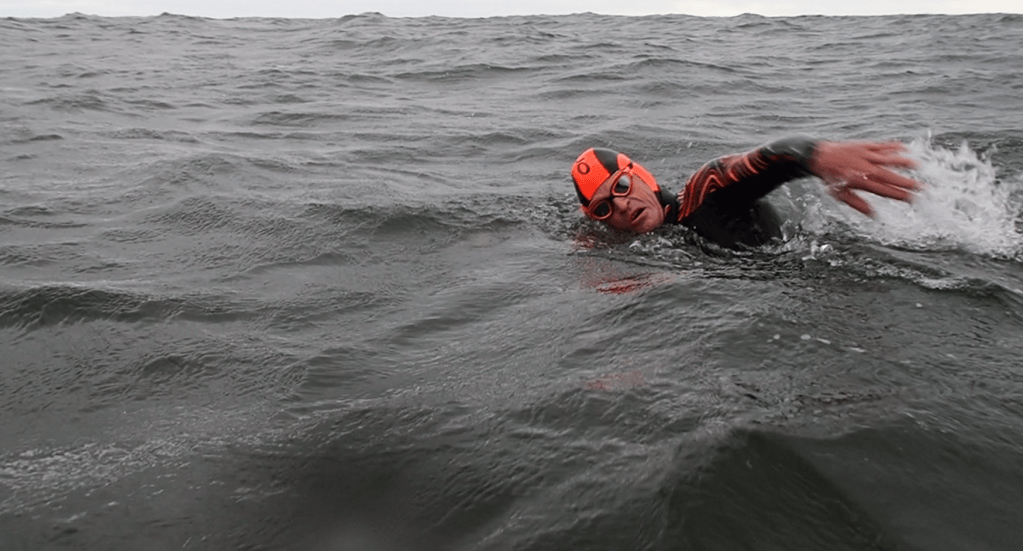
The forecast for yesterday looked middling but manageable: force 4 winds at 1pm, when we planned to start, which would then tail off through the afternoon.
When we arrived in Blackwaterfoot at midday, the sea did not appear to be obeying the forecast. The waves were mid-sized but piling onto the shore with attitude. A pair of swans swimming around 20 metres off the rocks headed for the mouth of the Blackwater Stream. One of them surfed a small wave into the safety of the tiny estuary.
The swans were onto something. Over the next half hour the sea’s agitation rose. The surface was almost as much white as grey. While not nearly as hostile as Thursday’s sea off Imachar Point, it was clear we would have to change our plans. So we hunkered down in the Kinloch Hotel over some really excellent sandwiches and stared at the sea.
The Mull of Kintyre’s ‘shark attack’
It wasn’t possible to see much of the Mull of Kintyre – the long peninsula that encloses the west flank of the Clyde Estuary. But it occurred to me that somewhere across the sound and a little to the north is the site of Britain’s only shark-related fatalities. The incident occurred in 1937 off the shores of Carradale, on the Mull of Kintyre. It was far removed from a scene from Jaws and was a terrible accident rather than an attack. But the human cost was devastating.
A couple of posts ago I wrote about basking sharks – the world’s second largest fish. Often termed gentle giants of the sea, they sustain their enormous size by eating zooplankton – creatures as minute as basking sharks are gargantuan.
One of many things that about basking sharks that no one fully understands is why they occasionally leap from the sea like elephantine trout. This is thought to be a form of social, perhaps courtship, behaviour or maybe an attempt by the sharks to divest themselves of parasites.
On 2nd September 1937, a pleasure boat sailing off the beach in Port Righ Bay, just off Carradale, disappeared from sight at the same moment that holidaymakers saw a basking shark leap from the water. In the words of one witness, interviewed by the Scotsman Newspaper:
“I was so amazed by the shark’s leap that at first I did not realise that disaster had overtaken the sailing boat. The shark must have charged right into the boat and thrown all the occupants overboard.”
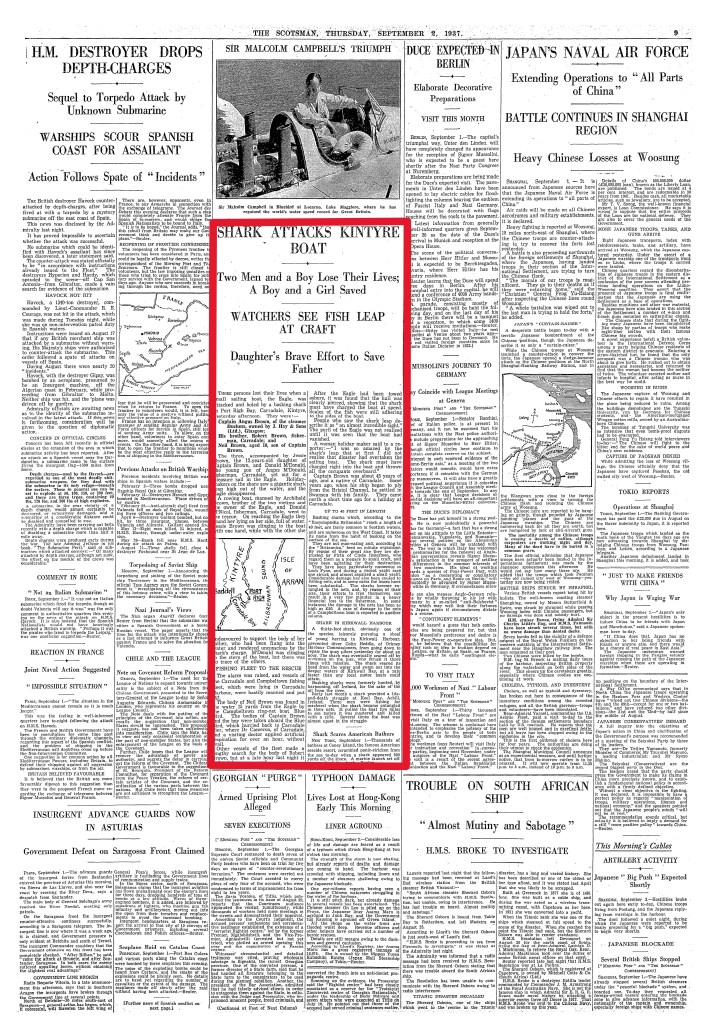
Three of the boat’s five occupants – Angus, Robert and Neil Brown – died as a result of the collision. Whether the shark struck the boat from beneath or whether it landed on the craft after it leaped, it seems highly unlikely that the contact was intentional. This didn’t stop newspapers from presenting the tragedy as a shark attack and stoking the perception that basking sharks were dangerous. As journalist Alex Renton writes:
“Questions about the “menace” were asked in the House of Commons, citing bathers “chased out of the sea” and fishermen afraid to go out on the water. The basking sharks, plankton eaters, were also accused of consuming the valuable herring. In 1939 the secretary of state for Scotland promised that Fishery Board cruisers would continue to kill all the sharks they could find.”
A glimpse of Ailsa Craig
As it approached 3pm and I was brimming with open sandwich of poached and smoked salmon with cream cheese and a side serving of crisps, Steve and I decided to go for it. The waves were easing and we wanted to get in a couple of hours swimming at least. The not very appealing alternative would be me attempting two swims on Sunday – totalling about 19 kilometres – to keep on track.
The waves had given the seabed a serious battering and displaced weed, silt and doubtless many small life forms from the bottom. I felt like I was swimming through miso soup. But it soon became clear I was going to get some help from the tide. There was little to look at and I got my head down. With the tidal flow propelling me down the coast, I found I’d covered 4km in just one hour.
Now, for the first time, I could make out Ailsa Craig, a 300 metre-high volcanic plug of rock that rises sharply from the Firth of Clyde around 20 kilometres south of Arran. The islet is an important breeding site for sea birds and has the status of a special protection area.
Traveller and writer Thomas Pennant visited Ailsa Craig in 1772 and wrote, in his A Tour in Scotland and Voyage to the Hebrides, about the bird life he saw:
“The birds that nestle on the precipices are numerous as swarms of bees and not unlike them in their flight to and from the crag. On the verge of the precipice dwell the gannets and the shags. Beneath are guillemots and the razorbills; and under them the grey gulls and kittiwakes, helped by their cry to fill the deafening chorus. The puffins made themselves burrows above; the sea-pies found a scanty place for their eggs near the base. Some land birds made this their house: among them ravens, hooded crows, pigeons, wheatears and rock larks; and what is wonderful, throstles exerted the same melody in this sign of horror as they do in the groves of Hertfordshire.”
Sliddery seaweed
My unearned velocity continued through the second hour and, 7.5km down the coast from Blackwaterfoot, we fetched up on a giant raft of seaweed the sea had vomited onto the shore.
We were close to Sliddery, a small village on the southwest of Arran. There were no landmarks but Steve had done a remarkable job of navigating us to a point near a thread of a track that led about quarter of a mile back up to the road. We stashed the kayak and squelched up to where I had parked my car.
Before leaving the shoreline, I made a perfunctory assessment of the mosaic of weeds we had landed on. I realised I could confidently identify all of about three species. I made a mental note to reacquaint myself with two books I brough to Arran which are entirely devoted to the topic of seaweed.
One of these I particularly like and would recommend even to people who have no interest in picking over strands of algal detritus on a dank September day. Miek Zwamborn is a Dutch artist, novelist and poet who lives on the Isle of Mull, around 100 kilometres north of Arran. Her book The Seaweed Collector’s Handbook, explores seaweed in history and as a source of medicine, food, income and artistic inspiration.
There is a section on recipes. I haven’t tried any of them yet. But, when I go back to Sliddery today I should probably see if I can harvest the core ingredients needed for Pepper Dulse Hung Curd, Mackerel with Oarweed or Carrageenan Cream.
It’s also possible that by the time I get there, the seaweed raft will be back in the sea and I’ll be swimming rather than walking through it. Either way, the forecast for today is good. I’m hopeful that, after three swims that have been more endurance than enjoyment, I might be able to see some more of Arran’s amazing marine life.


Leave a Reply