Through this swim around the Isle of Arran, I’m raising funds for the vital marine conservation work of Community of Arran Seabed Trust (COAST). You can donate via this JustGiving page here.
For my other daily blog posts, please click here.
On Tuesday, I didn’t swim due to strong westerly winds beating up the northwest coast of Arran. The upside was that I got to sit down with Elaine, Jenny, and Katy from Community of Arran Seabed Trust (COAST) at their office in Lamlash. They talked me through COAST’s community-based approach and some of their current priorities.
Katy had a request: could I spot sea grass beds between Catacol Bay and Pirnmill along the route of my next swim?
Local open-water swimmer and long-term COAST volunteer, Georgina, already identified several seagrass beds in this area when she completed a swim around Arran. Katy wanted to know if there were more.
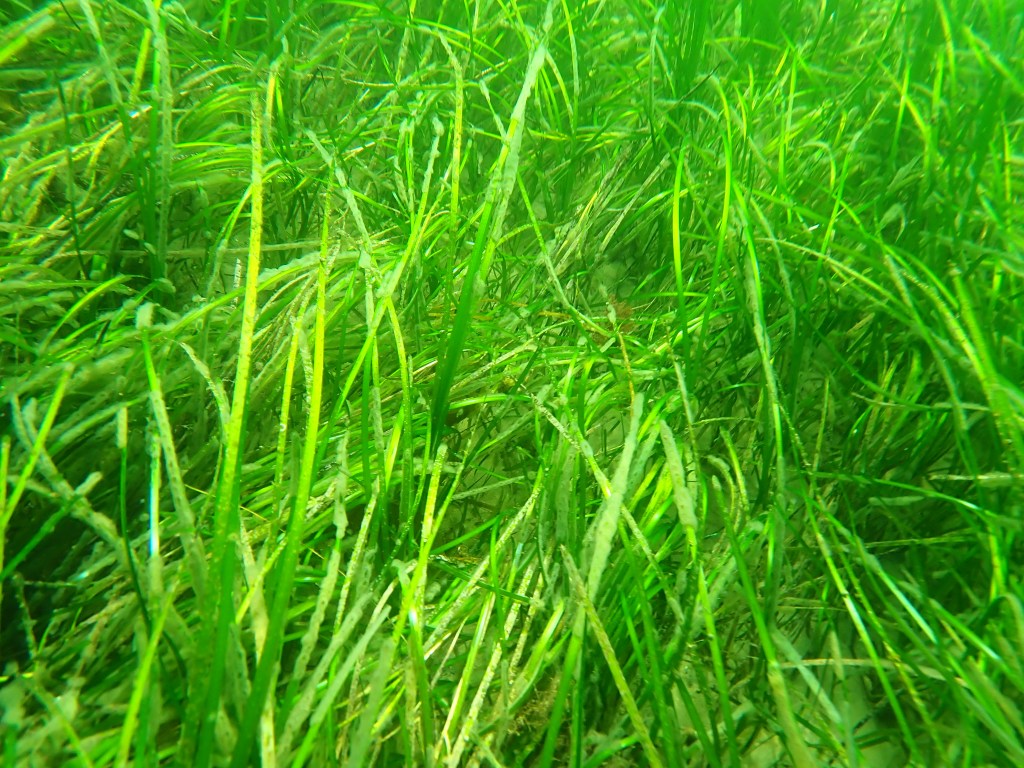
Why is seagrass important?
Seagrass meadows provide nursery grounds for juvenile fish and homes to many much littler lifeforms. Small seaweeds stick themselves to the blades, providing food for the fish. Manx marine biologist Fiona Gell writes that seagrasses “store carbon and are a secret weapon in the fight against climate change”. This is, in part, because they have deep roots, a bit like iris rhizomes, that fix carbon in the seabed.
I was flattered to be trusted with the task of looking for seagrass beds. But I had my doubts about my suitability, as I have a terrible track record when it comes to finding them. When I swam round the Isle of Man in 2019, the Manx Wildlife Trust gave me maps showing me where to look. I tried on two occasions and registered a double manhunt fail.
The first time I confused myself with my attempts to navigate using a map. The second time I got diverted by the distractions of an adverse tidal flow, a toe-tugging seal and a lash across the face from a lion’s mane jellyfish.
Walking home, I took it as a good omen that I was treated to an amazing rainbow (and partial second rainbow) marking out the No Take Zone in Lamlash Bay. It occurred to me that having one of those pointing out the seagrass beds during my northwest coast swim would be a big advantage.
Lochranza’s big beasts
Outside COAST’s Discovery Centre in Lamlash there is a chalkboard with recent sightings of marine animals on it. When I started my swim there on Saturday, the board recorded two sightings from the previous day of humpback whales off Lochranza. I was astonished. I had no idea that large whale species might be found here and humpbacks are seriously hefty, weighing up to 40 tonnes. The Facebook page Arran Cetacean Sightings includes dramatic footage taken from Lochranza pier on 4th September of a humpback whale breaching.
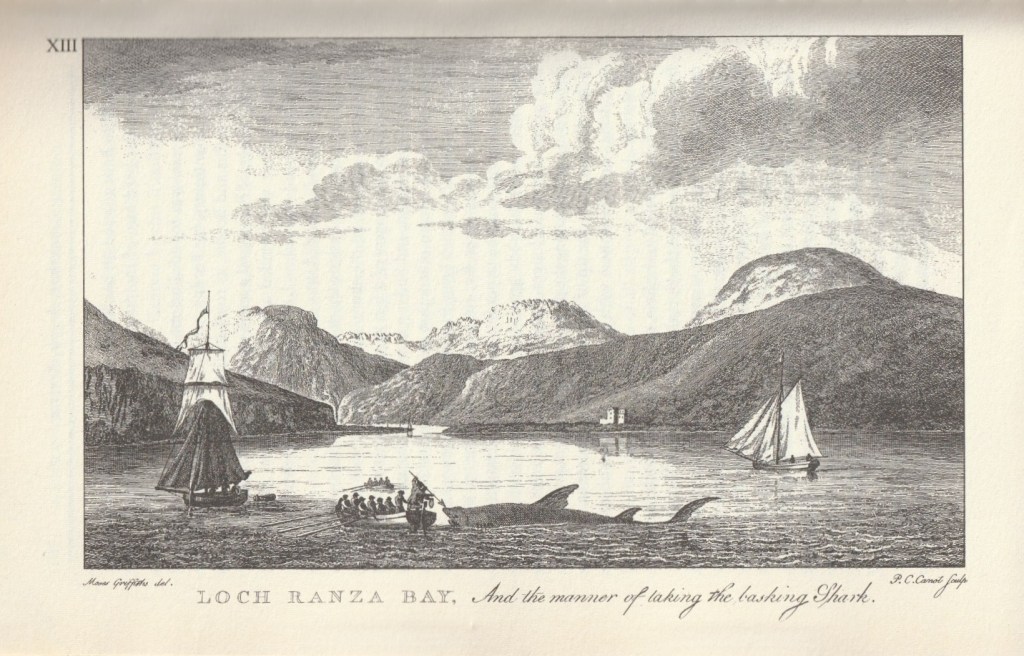
One of the earliest pieces of travel writing I’m aware of that covers Arran is Thomas Pennant’s A Tour in Scotland and Voyage to the Hebrides, 1772. Pennant describes a visit to Lochranza and his inspection of the carcass of a basking shark (the world’s second largest species of fish), harpooned a few days before. He describes the shark as:
“a monster, notwithstanding it was much inferior in size to others that are sometimes taken, for there have been instances of their being from thirty-six to forty feet in length…
“They swim very deliberately with their two dorsal fins above water, and seem quiescent as if asleep. They are very tame or very stupid and permit the near approach of man.”
Pennant says that, when realising they have been wounded by a harpoon, the sharks “swim away with amazing rapidity, and with such violence that a vessel of 70 tons, has been towed by them against a fresh gale: they sometimes run off with 200 fathoms of line, and with two harpoons in them; and will find employ to the fishers of sometimes twelve and sometimes twenty-four hours before they are subdued.”
The object of the hunt was the shark’s liver. “A large fish will yield eight barrels of oil, and two of sediment, and prove a profitable capture.”
Angus Martin’s authoritative book Fish and Fisherfolk of Kintyre, Lochfyneside, Gigha and Arran (thanks to John Hesketh of COAST for the recommendation) describes how the demand for basking shark oil for lamps declined with the advent of paraffin. However, efforts to revive the hunting of the sharks off the Scottish coast continued until the early 1990s.
Thankfully, basking sharks are now protected in UK waters. They are mostly left in peace to undertake their slow motion pursuit of zooplankton up the Irish Sea and along the coast of southwest Scotland. According to COAST, basking sharks are regular visitors to Arran’s waters.
The seagrass trail
Tuesday’s high winds clearly churned things up beneath the surface of the sea. When Steve and I arrived at Lochranza yesterday (Wednesday) morning, we could see flocks of black headed gulls in small rafts feeding just off the shore. Two gannets dropped out of the sky to hit the water simultaneously within a metre of each other. A third hit the same spot just a few seconds later. The water met the beach with a thick wreath of snakeskin-like sugar kelp fronds and uprooted wrack, woven with threads of feathery red weed.
The first mile of the swim was straight into what was left of the wind. But once into Catecol Bay, the conditions became easier and the scenery spectacular. To my left, Glen Catacol, a beautiful green and russet valley with a rim of small crags, carved a curved notch inland.
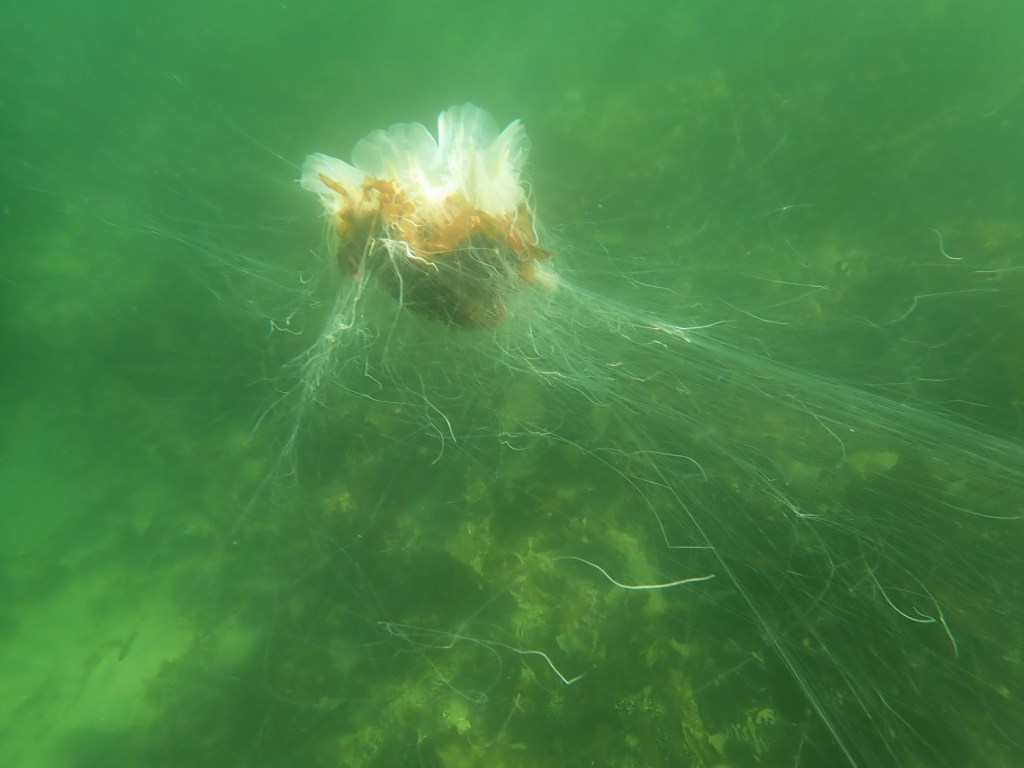
Out in the middle of the bay, the water was deep and I didn’t expect to see much. Just below the surface, I saw my tenth lion’s mane jellyfish of the day and couldn’t avoid my hands touching its tentacles. Fortunately I avoided being stung. Overhead, I had a flock of black-headed gulls for company. Perhaps they hoped I’d massacre some local sea creatures whose remnants they could feast on. Or maybe they had figured out that I was about to expire and offer them a floating meal, shrink-wrapped in neoprene.
But then the real avian event of the day flew into view beneath me. Fragments of TV nature programme memories shouted “Penguin!”. After a couple of seconds, I realised it was a razorbill. And it really was flying – short wing beats carrying it in a smooth and speedy arc. It performed a neat semi-circle around three metres beneath me and then flew off. I didn’t see it come back to the surface.
Coming out of Catacol Bay, I started looking out of the seagrass. There were so many green dots on the map Katy gave me. Surely, after the miserable returns of my two seagrass quests off the Isle of Man, I couldn’t fail third time around.
So it was with relief and excitement that I began to pick out what might be a seagrass meadow. The bare sand a few metres below began to acquire tufts of matted, khaki follicles. The sparse clumps became a shaggy pelt. Then the sun came out. At the flick of a switch, the subdued khaki sprang into a riot of chlorophyl. Juicy green ribbons in a dense carpet waved up at me. I dragged my wetsuit below the surface and swam through the meadow with the leaves brushing my chin. Tiny wide-eyed fish peered out from their nurseries between the stems.
I didn’t dare switch on the GPS function on my camera, as it instantly drains the battery. But I am very confident in my conclusion that I discovered no new seagrass fields yesterday. What I did find was pure delight in finally getting close to this luminous sub-sea landscape for the first time.
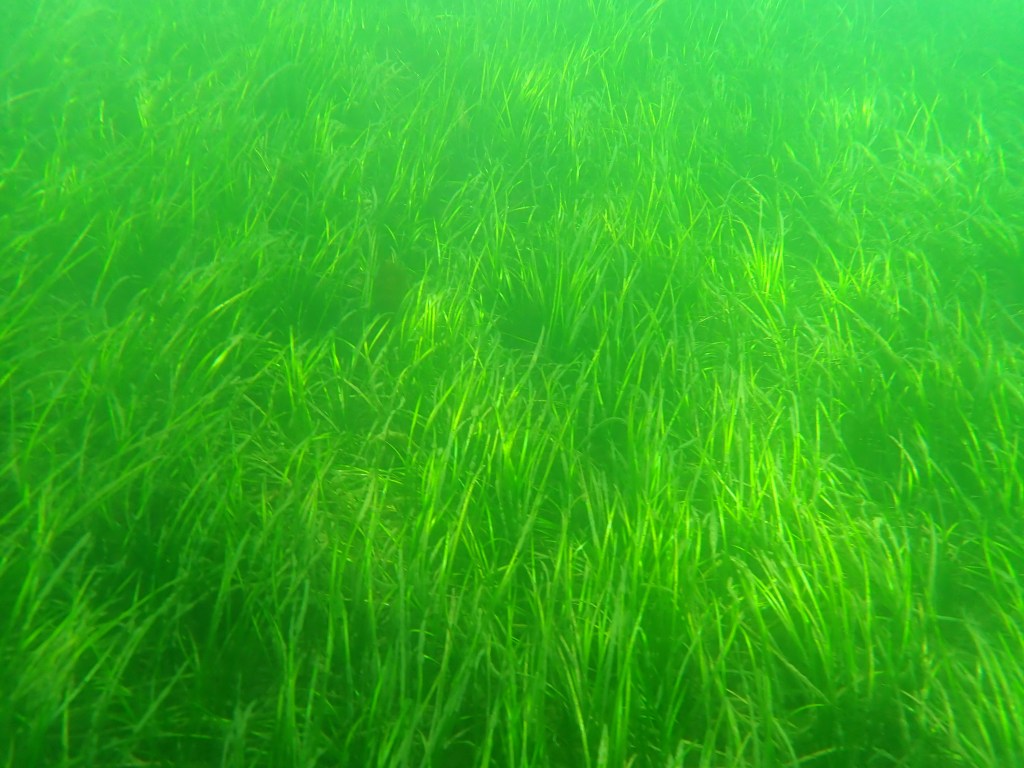
The seagrass formed a long corridor down towards Pirnmill. The stems bent south in the receding tide and I moved forward with a happy illusion of speed and dynamism. Eventually I was out of the meadow and over sand banks where my finger tips left small craters amidst the worm burrows. Then the sand gave way to groves of kelp where I could pick out lilac-tinged sea urchins and a tangerine-coloured seven-armed starfish.
I was slowing down. So I felt vindicated when Steve pointed out a marker buoy bending towards us, signalling we had entered an eddy that was pushing us back. By the time we reached the spot where we left Steve’s car, near Imachar Point, I was pickled and shivering from over five hours in the water. We had covered 14 kilometres, which felt really good after losing Tuesday.
On the drive back towards Lochranza, Steve spotted an otter swimming a few metres off the shore. I had never seen one so we stopped. The sun was dropping over the Mull of Kintyre, casting the otter as a sinuous black etching on the pewter sea.


Leave a Reply